Friday, April 28, 2023

William Hobbs Preston

 From the 1950s writings of Ella Preston  ( see more ) 


My Father (Ella Preston's Father) William H. Preston was the oldest of the children. He was born in Worcestershire, England August 15, 1838. 

At the age of 23, William was involved in the Civil War. He served from 1861-1865 for the Union (Co.C. 20 IA INF). 

In August 1865, at the end of the War, he joined his brother Tom aboard a steamboat on the Mississippi River to return to Davenport. In Davenport they were to be mustered out of the service and return to civilian lives. The steamboat was slowly making its way up the Mississippi and one night, somewhere below Cairo, Illinois. William and Tom along with the rest of the returning soldiers were asleep on the deck. Suddenly, steam and sparks flew out of the stacks of the steamship. It showered down on the sleeping men waking them in a panic. Tom made a jump to get off the ship. William grabbed for him as he went over the side. His fingers raked Tom's trouser leg but he could not hold him. Tom was never seen again presumed drown. 

William continued his trip to Davenport to start his life. He would find himself married 3 months later.

Friday, February 10, 2023

Searching for Leonard’s Biological Father

 Searching for Leonard’s Biological Father

Leonard, was the Grandfather my family knew nothing about.

He was Leonard Muffitt.

The reason so little was known is in 1917, Leonard’s wife, Ruth Preston Muffitt died giving birth to twin girls. For reasons unknown, Ruth’s mother Daisy Preston raised the twins with Leonard NOT being involved with them in any way. One of the twin girls was my mother.

We knew nothing of Leonard Muffitt. My mother or her sister, if they know of him, they never spoke about him. The name Muffitt was only seen when flowers were place on Ruth’s grave. Her tombstone is engraved “His wife Ruth Muffitt”, but there is not a grave beside her grave for her husband.  In the mid 1960’s, my mother asked me if I could find her father’s grave.  She told me she thought his name was Leonard. I started researching.   But with limited information, I found nothing.

Technology advanced.  About 1990, I created a website concerning my Great Great Grandfather, Judge Preston of Dodge City, Kansas. Judge Preston’s grand daughter Ruth Preston was married to Leonard Muffitt.  A few years later, a descendent of Leonard’s half sister found the Preston website and contacted me. This was a huge surprise. I knew nothing of Leonard. 

I learned the following: 

  • Leonard lived for many years in Kinsley, Kansas (not many miles from Dodge City where my Mother and her Sister were raised) 
  • Leonard got married again and wanted to get the twins back … but for unknown reasons, that did not happen. 
  • Leonard and his new wife had no children of their own but adopted and raised two girls. 
  • Leonard died in 1954 
  • And to my surprise, I learned that Leonard was not a Biological Muffitt. His biological father was unknown.


The search for Leonard’s biological father begins.

 Ancestory.com before DNA was very helpful.

Leonard Leroy Muffitt was born September 7, 1890, in Mackville, Kansas to Mary Ann “Molly” Johnson. No birth certificate has been found.  She was the 22 year old daughter of William H. H. Johnson who was trying to put together a life after serving with the Union in the Civil War, and having his wife die leaving him with young Mary Ann and her 2 year younger sister. William H.H Johnson remarried had three addition children.  That is the what the Johnson family looked like in Mackville, Kansas in 1885. 

Family stories said Leonard's biological father was "the Handsome Mr. Darling". Well, that was a clue.  Five years after Leonard was born, the 1895 Kansas census in Mackville listed 4 year old Leonard, and his mother Mary Ann, living with Mary Ann's new husband Alonzo Muffitt and two of their young children, AND Leonard’s surname was listed as Darling.

Census data had earlier shown that there was some Mackville residents with the surname Darling. But that is all the information there was to go on. 


Ancestry.com with DNA

With recent improvement to DNA testing, I began the DNA journey with Ancestry.com. I was hopeful through DNA, the connection might be easy, and Leonard’s biological father could be identified.

When the initial DNA matches came in there were many to sort through. I know the paternal side of my family fairly well and I knew half of the maternal. I spent a few days sorting and building my Tree. There were many 1st & 2nd cousin matches that I knew and could easily place in my tree. But I started to see some unknown DNA matches. I begin to notice that many of these unknown matches also matched with each other. To my surprise, I saw no immediate DNA matches to the name ‘Darling’.

On a close match, that I did not recognize, I looked at their tree and saw that their grand parents lived Kansas. What caught my attention is that they lived 60 or so miles from Mackville, Kansas. I then searched for their great grandparents and discovered their great grandmother's maiden name was ‘Darling’. A little more research and I saw that this great grandmother Susannah Darling and her husband Calvin Chase were living in Mackville, Kansas around 1885. 

With this information, family stories and a DNA link that connected me to a ‘Darling’ in Mackville, Kansas, at the correct time, I thought I was on the right track!

I quick Hypothesis was a BROTHER of Susannah Jane Darling might be the biological father of Leonard.

 I made the following Ancestry Comment and reached out to members and matches that may have information.

————

Looking for biological father of Leonard.

Mother is Mary Ann Johnson (1868) residing with her family in Mackville Kansas. Father probably is a Darling and I suspect it could be a brother of Susannah Jane Darling born between that would be born between 1850 - 1870.

Possible Brothers are:

Andrew Jackson Darling 1864
Married 1894 to Lena Smedly (then divorced) she died in 1935
Married 1909 to Anna Denslow (she was 19 and he was 45)

Julian George Darling 1870
Married 1901 to Dolly Barrett
Married 1920 to Charlotte Stuart

Fred Henry Darling 1871
Married Florence Ivey 1893
Daughter born 1894

Lewis Orestus Darling 1872
18 when Leonard was born.
He is a little younger than Mary Ann.
In 1900, he was head of household and Single living with His Mother.
Married Lulu Parker in 1904 (Lulu died in 1912)
In 1950, at age of 77, owned/working on farm Widowed.

Any clues appreciated!

————

As I continued to look at DNA matches, I continued to find many of my unknown 2nd - 4th cousins predicted matches were associated with other unknown matches creating an unique group. This group of matches had a common link to Calvin O Chase and Susannah Darling Chase.  I just needed to have a connection to a brother of Susannah Darling Chase.  But.That. Never. Came. 

As I continued researching my DNA connections, I continued to discover my matches were with both Calvin's O Chase’s children's descendants AND of the descendants of Calvin's Siblings.  The connections did not have to go through Calvin and Susannah.  In addition, I found ZERO DNA connections with a  ‘Darling’, Susannah Darling or and surname Darling.  I started to question my original "Susannah Darling's brother" hypothesis.

Then I did find one Ancestory member, that I had no DNA match with. This member seemed to have the same people in their tree.  I saw that this member had an image with their DNA connection to Susannah Darling Chase, through one of her brothers and a connection to other members of Calvin and Susannah Chase descendants that I connected with. I took this to mean that I was NOT related to Susannah Darling Chase at all. That ended the original "Susannah Darling's brother" hypothesis.

But it was indeed interesting that I had many DNA links to Calvin O Chase, Susannah’s husband. 

More DNA matches continued to reveal the same thing. I had over 50 matches that linked to Calvin O Chase with varying percentage of DNA. I worked at placing Calvin in my tree so that the all of the found matches best fit with the shared DNA percentage predicted for the relationship. Maybe an  Uncle?, Cousin? … none worked. 

Placing Calvin O. Chase as Leonard’s biological father did work.  

Placing Calvin O. Chase as Leonard’s biological father made every DNA match connection that I had examined and placed in my tree thus far, a high predicted relationship given the DNA share. There were zero exceptions.

 At this time (02/01/2023), the high probability Matches Placed in the Tree with Calvin O Chase as Leonard’s biological father results:

Descendants of Calvin:
19 half cousin matches

Descendants of Calvin’s Siblings:
23 cousins

Descendants of Calvin’s uncles/aunts:
9 cousins

As I continued to place new found matches into the tree, each match placement was highly predicted given the shared DNA.   I have found ZERO exceptions to this. 

There are over 45,000 Maternal DNA matches that I continue to work through. 

I estimate about 5,000 are DNA are distant connections to the Great Grandfather I did not know. I will continue to research. But for now, I strongly believe that Calvin O Chase was the father of Leonard.

As new close matches come in, perhaps more will be revealed. 

But if anyone has a DNA connection to Calvin O. Chase, I ask that they check to see if their DNA matches with mine and let me know what they find.


Epilogue

The search for Leonard’s biological father did not go the way that I thought it would go. 
It was a total surprise. 
It may surprise others as well. 


The Mackville, Kansas Mystery

 •How did the “Handsome Mr. Darling” family story came about?  

•Why does the 1895 Census list Leonard as a Darling?  

•Did Mary Ann know Calvin Chase was Leonard’s Father?

•Did Leonard know Calvin Chase was his biological father?

•Did Calvin Chase know Leonard was his son?

•Did Calvin’s other children know Leonard was their brother?


 I think about what Mary Ann must have went through living in small Mackville under the circumstances.

I think about what Mary Ann’s family went through. 

I think about what little Leonard went through.

I think about what Calvin went through. 

Mackville, Kansas in 1890 is a mystery. 

Yes, history rhymes, so I also think about what agony Leonard must have felt watching from a distance as his twin girls grew up. 

Stephen Smith
2023

Saturday, May 18, 2019

Mule Head Hill - Santa Fe Trail - Judge Preston Homestead


DAR Marker Number 62; Mule Head Hill - Mule Head Hill - Santa Fe Trail l

(William Preston and family at this location is the 1880 Census)

Information found at the Santa Fe Trail Research Site

The Top of the Trail
 Dodge City Daily Globe - 1931
     There is a certain prominent hill in northeast Ford County. It rises gradual and sublimely from surrounding vastness. A view from its summit is rare when considering distance. An estimate of the number of homes visible from the hill is nearly 150. Light of eight towns may be seen at night from the hill. In every direction of the land slopes for miles. Its greatest slop, however, is toward the sough and east where in the distance the sand hills beyond the Arkansas river melt into the mellowness of the sky. The writer stood upon this hill one day and remarked to the owners that with such a splendid view an appropriate name for their farm would be "Wonder View Acres" or "Buena Vista Place". They informed me that the place had always been known as "Mule Head Hill' and that they felt obliged to call their farm by that name. Not a very euphonic name, the writer lamented, but reconsidered. Neither was Boot Hill nor Horse Thief canyon, but their place in history had made their names seem beautiful to those who appreciate the past. With due respect for the past, the writer proceeded to learn how the hill got its name. It was difficult. Many of the older residents and students of history were questioned. All knew its name but opinions differed slightly as why it had the name.
     As early as 1822 a shorter route was taken by the freighters enroute to Santa Fe. This hill rises about midway between the Pawnee Fork and the Caches near the present site of Dodge City. Water was scarce along this route. Winter snows did not drift badly along it, and for these reasons it was used, no doubt, more than the river route during the colder seasons. However, water was available at both the creek crossing near the present site of Kinsley and at the Coon Creek crossing southwest of the hill. Thus the route could be used at all seasons but usually the heaviest travel was made during the month of June. During the trail days of 1822 to 1872 the hill was used as a lookout point for stealthy Plains Indians. Although no single tribe claimed this region, the Cheyenne's no doubt found both the Sawlog valley to the northwest and the Arkansas valley to the southeast to be favorite haunts. The uplands between these two streams were splendid grazing lands for the buffalo, which roamed the prairies in great numbers at that time. Nomadic tribes vied with each other in hunting down the buffalo on these plains. They resented the idea of the traders, soldiers, forty-niners and settlers for they to shot down their buffalo for food along the trail. The tribes soon learned from stealthy observation the value of the freight and made the route a perilous one for all of those who traveled it.
     Evidences were found by early settlers that would indicate that battles with the Indians had been fought along the, west slope of the hill. Bows and arrows, bullets and empty shells have been found there. A further clue to such a battle lies in the fact that human bones were found by the present owners when excavating for their basement about twelve years ago.
     It is little wonder that the hill was used as an observation point, for Indians, since not only many miles in each direction along the cut off but also a considerable distance along the river route could be viewed from its summit. It seems a bit strange that the trail led exactly over the hill in place of around it. Its very summit seemed the objective. It is believed by some that valuable supplies and even large sums of money were buried on this hill.
     The reason for its name, however, lies in another of the hill's uses. Tradition says it was used as a mule supply point for the trail. From fifty to one hundred mules were kept pastured near the hill and were herded into a strongly built stockade on top of the hill. Mexicans having used mules for transportation since earliest times, were employed to a great extent both along the trail and at the hill to care for and handle the mules. Being about a day's journey from the Pawnee Fork the freighters used the hill as an overnight campsite. Authorities agree on that and also that a supply of mules was kept there to serve the needs of the freighters.
     In earliest times freighting was done with pack mules. A caravan numbered fifty or more mules, each loaded with about 300 pounds of freight. Wagons were first used in 1822 when traders left Missouri with twenty-five wagons and a train of pack mules. It proved so satisfactory that the caravans of pack mules alone were used less and less. But in either case fresh mules from the supply on the hill were used to replace the fagged out ones. Some authorities relate that only the lead or "Lead" team was replaced by a new team each time the freighters arrived at the hill. Others say that when a heavily loaded freight outfit was sighted approaching the hill, extra mule teams were sent out from the government's supply on the hill and hitched to the "Lead" team to help the outfits over the hill. In either event the hill was used as a mule supply.
     After more than a century the trail is almost obliterated, yet there may be seen angling across the remaining bit of pasture land several parallel depressions almost leveled by the intervening years and over grown with a greener buffalo grass.
     The present owners are Mr. and Mrs. Paul Herrmann who with their three daughters live on the very summit of the hill. Former residents were the late Judge Preston and his family.
     A granite marker has been erected at a spot where the old trail crossed the hill. On it is the inscription: "Santa Fe Trail, 1822-1872, marked by the Daughters of the Revolution and the State of Kansas, 1906." Scratched on each side of the square cement base are pictures of a mule's head with its proverbial long ears. The marker stands as a monument to the memory of the old trails. It is mute evidence of the tragedy and terror, valor and vigil, rigor and romance of the early day. Would that the hill itself could speak, reveal its mystery and relate the actual part it played in the winning of this great southwest.
Author -*- Mrs. K. K.
[Given to the Kinsley Library by L. L. A.]


Mule Head Marker


The only hill for miles overlooks the great sand dunes in the big bend of the Arkansas. On a clear day, Fort Larned could be seen to the northeast. The Marker is at the apex of the hill in the wheat field. 

This is multi-generation farm and the family will not consider having the Marker moved. To see it you must walk. There is a carving/drawing on the back of the base of a mule's head. 

US 50/56 to 134th Road, south 2 1/4 miles to the homestead with two houses on the east side, follow the driveway to the south house, the Marker is approximately 100 yards south in the field.


This Marker is on "Private Property" and should be treated as such!

Section 26, Township 25 South, Range 21 West
GPS:  37°50'58.0"N 99°36'17.4"W   

* note:   This is the Mule Head Hill that Ella Preston remembered riding a horse going to school when she lived on the homestead.    William Preston and family at this location in the 1880 Census)

Friday, February 15, 2019

Happy Birthday

Ruth Preston Feb 15, 1894


On April 23rd 1916, Ruth (22) and Leonard (26) were Married at the home of the Bride in Cimarron, Kansas.

Ruth was a teacher, Leonard a farmer
Ruth and Leonard had a baby die after living only 5 days.

A year later Ruth had twin Girls.
It was said that Ruth had a premonition of her death and the birth of twin girls and told Daisey what to name them (the light one Dorothy Ruth and the darker one Louise Mary.

Ruth died that day .... Nov. 10th 1917 at the age of 23.

Friday, May 11, 2012

We have had a lot of visitors....  from all over the world.

the Blog has been redone a bit to make it easy to find information.

Please leave a comment with any questions or information that you might have.

thanks

Sunday, January 01, 2012

Preston's of Dodge City Kansas


This is the Preston story (England, Davenport Iowa, and Dodge City Kansas).

It was constructed from a number of letters Ella E. Preston had written to Dorothy Ruth Preston Smith about the family as she remembered it. The letters were written in the mid 1950s.

Stephen W. Smith


Thomas Preston lived Worcestershire, England near Severn on the Thames. He was an expert horseman, a complete authority on horses. For several years he was chief hostler on The Squire's Estate. His duties were to see that the other hostlers and foot-men performed their duties. Prestons in England
Thomas Preston brought his family to America from England on the Ship General Dunlap Liverpool, England to Philadelphia, Pennsylvania in November 1853. His wife, Elizabeth Hobbs, was a peasant but a wonderful woman. Their children ranged from William 14, to Maria who was born on ship as they came to America. The ship was a sailing vessel and it took them a month to complete the crossing. They landed in Philadelphia where they lived for several years before moving to Davenport, Iowa. Besides William and Maria there was Charles, Mary, James, Tom, Agnes and Annie.

My Father (Ella Preston's Father) William H. Preston was the oldest of the children. He was born in Worcestershire, England August 15, 1838. At the age of 23, William was involved in the Civil War. He served from 1861-1865 for the Union (Co.C. 20 IA INF). In August 1865, at the end of the War, he joined his brother Tom aboard a steamboat on the Mississippi River to return to Davenport. In Davenport they were to be mustered out of the service and return to civilian lives. The steamboat was slowly making its way up the Mississippi and one night, somewhere below Cairo, Illinois. William and Tom along with the rest of the returning soldiers were asleep on the deck. Suddenly, steam and sparks flew out of the stacks of the steamship. It showered down on the sleeping men waking them in a panic. Tom made a jump to get off the ship. William grabbed for him as he went over the side. His fingers raked Tom's trouser leg but he could not hold him. Tom was never seen again presumed drown. William continued his trip to Davenport to start his life. He would find himself married 3 months later.

Warren Cheney Brunson was born in Ithica New York. His parents were from the Welsh Highlands. Warren Brunson a tall distinguished looking man, was a candy sales-man and manufacturer. Later he turned to woodworking and millwrighting owning his own business. He married Sarah Carlyle, a physician, in about 1843. Her parents were both physicians also, her Father an Englishman and her mother, a Sherlock was Scotch. Warren and Sarah Brunson had three children. Warren Jr., Parmelia and Allison. I recall a story of a rough looking man pounding on the door of Warren and Sarah Brunson's home. He called Warren out to the porch and told him, "I want your wife to come with me to treat a wounded man. He is in Horse Thief Canyon about a mile north of Davenport. She will not be harmed and she will be able to return when he is recovering." Warren said goodbye to Sarah as he looked down the barrel of the stranger's gun. She did return safely.

My Mother (Ella Preston's Mother) Parmelia Annette Brunson was born in Great Barrington, Massachusetts at the foot of Saddleball Mountain, May 14. 1848. She along with her family moved to Davenport, Iowa shortly after.

My Father and Mother, William Hobbs Preston and Parmelia Annette Brunson were married in Davenport, Iowa November 9, 1865 in a Baptist Church (although the Davenport records show it as November 11, 1865).


William H. Preston & Parmelia Annette Brunson Preston


1209 2nd Street, Dodge City, Kansas W.H. Preston in front


He was 27 and she was 17. Parmelia was a Baptist and William was as Episcopalian. A few years later he was converted and joined the Baptist Church. Not only did he change religious faiths he also had to become a naturalized American citizen. Even though he fought for four years for the Union in the Civil War he still could not vote (being born in England).

William and Parmelia had four children, William Charles born December 26, 1868, in Jackson, Michigan with Parmelia's uncle Dr. Bronson (that is how he spelled his name) in attendance. On May 12, 1871, George Henry was born in Davenport, Iowa.
Then I was born, Parmelia Elizabeth (Ella E. Preston) in Kansas City, Missouri, February 3, 1882. 

My Father William Hobbs Preston was a letter carrier in Davenport when he was not learning the carpenter trade or helping his father-in-law Warren Brunson. (1870 cesus show he also was a grocer) Before the winter of 1877, at the age of 39, the doctor told him he could not survive another cold Iowa winter. The doctor told him to consider the New Territory opening up in the Southwest. The New Territory was supposed to have an ideal semi-tropical climate.

So in the fall of 1877, he went, by himself, to the Southwest. He filed a homestead claim and built a sod house.    

(note: 1862 Homestead Act. Allowed settlement of public lands and required only residence and improvement and cultivation of the land. Any person, a citizen or person intending to become a citizen, 21 years of age or older, and the head of a household could make application. With five years residence and improvements/cultivation, only a $15.00 fee was required to get 160 acres. Repealed in 1976. )


He returned to Davenport in the spring with tales of the wonderful mild climate and to get his family. That same spring (1878) my mother and the two boys (William C. age 10 , George H. age 7) made the long journey to the sod house
and limitless prairies. They left their comfortable house in the City, Father stayed In Davenport to make a living and put a little away while Mother and the two boys held down the claim. (1880 census shows that William was a farmer)

Mother at age 30 had never spent a night in the country before. The vastness! The stillness only broken by coyote howling was terrifying to her. The settlement was scattered and houses few. The settlement was in a radius of 6 to 8 miles. Mother said “I could stand in the yard and count 7 lights at night." Then came word that the Cheyenne Indians were leaving their reservation to the south, and going back north-west. Their trail was to lead right through the country where the new settlers were. Mother knew nothing of the planned Indian raid, till one morning she saw a horseman riding up the lane. She went out in the yard to meet the stranger, her hand ready on the gun in the pocket of her calico skirt. He said, "I'm a scout sent out to see where the redskins are and to see if there are any settlers here in the prairie houses." He told her to stay out of sight and watch. He said he would come back if he saw any danger. Mother and the boys gathered up quantities of big tumble weeds and piled them in a near creek. They put a jug of water and some food there and prepared to spend the night in the tumble weed shelter out of sight. About 11 O'clock AM, Ed Ott came riding out. Ed Ott, a lumber-man and new friend who lived in Offerle, about 5 1/2 miles north-east, had missed her when the lumber wagons rolled into town with all the new settlers and what household effects they could haul, but no Mrs. Preston and her boys. No one knew anything about her when he asked so he rode out to see. He saw that she and the boys where alright so he went out south to look for the Indians. He returned about 4PM and told her that the Indians had changed their route going a little west of her and north to avoid Fort Dodge. Then he told her, as the scout had done, to stay home and guard her possessions against thieves. It seems that she did not know her neighbors. The neighbors were always roughly dressed, in duck clothes with gunny sacks wrapped around their legs and feet. She was afraid of them. They were different. She had never seen anything but city clothes and city people, so I think the neighbors misunderstood her distant manner as snobbish and they left her and the boys alone. But she was a crack shot, and able to defend herself against anything in reason. The Indians went west of Dodge City, with the Fort Dodge soldiers following them at a safe distance, at least they did not catch up with them until they had massacred at least one family on a creek called the White Woman.

The Preston's (William H., Parmelia & family pictured W.H., Will, Ella, Parmelia, George) like all pioneers had their trials. They got a team and planted crops year after year. And year after year something happened. They were dried out, grass-hoppered out, hailed out, then dried out again (economic & demographic report of the area during the time). Every fall they went back to the City to make a living. One fall they went to Davenport. The next fall and for two more they went to Kansas City. I came back with them on the last trip from Kansas City in 1882 at the age of two months.

When it wasn't the lack of rain, the grasshoppers or the Indians their was the outlaws. Father had a run in with the now infamous Bat Masterson of Dodge City. Father was instructed to vote a certain way by the Wheatland Caucus. Bat came by to "make sure" the vote was cased the "correct" way. Bat said, "vote like your suppose to vote or I'll plaster you across the building." Bat was a big, well built man, Father slender and about 5'6" or 5'7". Father said, "Just maybe you will." A confrontation would have developed but something in Fathers piercing blue eyes or the way he said it, made Bat walk away.


In the meantime, Grandfather Brunson (Warren) had died. I think it was the last winter my parents spent in Daven-port. I was about 4 years old when my baby brother Albert was born. He lived only about 6 hours. I remember burying him in the backyard. Grandmother Brunson (Sarah) was with us then. I remember my mother telling me about the time that she was at age 13, her and her mother (Sarah) went to visit Sarah's mother at the beginning of the Civil War. Sarah's mother (Dr. Carlyle) was 80 years old then but they would go into the woods looking for herbs for medicines. Grandmother Brunson died about 3 or 4 years after baby Albert died.

Will, George, Parmelia E, and I all went to school in No. 6 in Wheatland TWF. Mother and Father helped organize that school district in 1878 or 1879 as soon as they arrived to the territory. I went there one year and one winter to Offerle School, riding horseback 5 1/2 miles morning and night when weather permitted. That I remember well. There was a long hill called Mule Head on the way.

In August 1896, we sold the farm. Father was 58 and Mother was 48. We moved to 1209 2nd Street, Dodge City, Kansas. I attended to Second Ward School and High School. Mother was a Good soprano singer. Also witty and so well read she could carry on a conversation on any topic. She had a keen legal mind and delighted at matching wits with lawyers she knew. Father (William H. Preston) was Probate Judge for 10-12 years in Dodge (records show that he married couples as well). Completely self educated, he was considered a good and fair judge and could have held the office longer had his health permitted. He resigned in January 1913 at the age of 75 and we began our Florida winters arriving there January 13, 1913.

Soon after the turn of the century Grandmother Preston (Elizabeth Hobbs Preston) died. Several years later Grandfather Preston (Thomas Preston) died. This was the generation that brought the Preston family from England.

William Hobbs Preston (my father) died April 23, 1918 at the age of 80. Parmelia A. Preston (my mother) died September 14, 1930 at the age of 82. They are buried in the Preston area at Maple Grove Cemetery in Dodge City, Kansas. WH Preston , Parmelia (The graves are in the old section of Maple Grove new the Civil War monument.)


Parmelia E. died June 10, 1967 at the age of 83.


A little about me (Ella Preston) and my family:
I taught school a term or two in the country at age 16 till I was old enough to teach at the Second and Third Ward Schools in Dodge City. You see, coming from an un-graded country school, I had an advantage over town children, when we moved into town. I was put in a grade ahead of my age. Then I went to Teachers College in Emporia. Kansas and held a lifetime teachers certificate. In 1911, I stopped teaching and learned telegraphy in the Santa Fe dispatcher's office. In 1912, I took the job as manager of the Western Union at Pratt, Kansas. I resigned in November to help Father close his Probate office and went to Florida with the Folks. In 1913, I was manager of the Western Union in Council Grove, Kansas, for a few months again taking time off to go to Florida. And so on til 1917. I managed the Postal Cable Company from September 16, 1913 until they made it a commissioned office September 29. 1939. After that I worked as a telegraph operator until they sold out to Western Union November 6, 1943.

I married Fred Kesler September 2, 1931. He died November 3, 1942 and he is buried in the Maple Grove Cemetery. He was a watchmaker, engraver and jeweler and left his shop to me. I already knew something of the business, from running it during his long sick spells so I then went to Kansas City to school to become a watch repairer. I owned and operated the Watch Hospital at 108 W, Chestnut in Dodge City until Feb. 22, 1951. I worked on the same block almost 33 years between the Postal and the Watch Hospital. I moved to 1209 Second Street February 22, 1951 the same house that my family moved to in 1896.


On June 23, 1946, I married Clarence Canaday he is an expert leather worker and saddle repairer. In his younger days he was a shoemaker, and operated a steam engine for 18 years. He is also a plumber and carpenter. He was born in Begard, MO Oct. 12, 1889. He came to Kansas in 1905.


My siblings:
Will (William Charles Preston)


Was a surveyor by trade. He was quite a poet, writer of interesting articles and a fair pen artist. When he was young, he was a good reader and was often called upon for entertainment. Here is an example of his poetry:

DODGE CITY, KANSAS
Said Uncle Sam in an early day
Whiskey must be kept at least five miles away From the Government kept Fort

He sure knew what he was talking about
for when whiskey gets in, their wits step out,
Then someone on money bent
Set up on the prairie, a little old tent.
The location, you see, just suited him fine,
For it was just over the five mile line,
In business there he started up
With a barrel of whiskey and a tin cup.

Others started a little store.
The gamblers and cowboys came by the score.
Dodge City was in full away
And has been up to the present day,
Things were different then from now.
At present most of the land is under plow,
Where thousand of cattle once roamed the plains
Now are covered with fields of grain,
What was Boothill when the gun did rule,
Now, there stands the Third Ward School,
And the town, for which we fought and slaved, Many of the streets today are paved,

W.C. Preston


George Preston


George was a carpenter by trade.


He was a good baritone and bass singer. He was known by all his friends for his ready wit and quick repartee. George died October 24, 1929 at the age of 58. He is buried in the Maple Grove Cemetery in Dodge City, Kansas.


……………………………………
This concludes the writings of Elle E. (Preston) Kesler Canaday. She died June 13th 1967 at the age of 85. She is buried beside Clarence Canaday in the Maple Grove Cemetery in Dodge City.


Clarence died March 20th 1971 at the age of 82. Elle was a very proper and educated woman. Her home was full of books and fine furnishings. I remember her being all dressed up and driving her 1930 Model A Ford around town in the early 1960s. She made a number of trips from Dodge City to Florida in that car.
She too had a flair with the pen. Here is a poem that she wrote while in Florida in 1929.

My Little Path
I tried to find my little path
That led around the brook.
And the log beside the brook left
A quiet, sandy nook.
Where I watched the shining fishes
Playing in the shining stream,
While I toyed in idle fancy
With some new, fantastic dream.

Now the path is gone.
The brook is dry.
A road runs in its place.
For Nature's art must step aside
When progress sets the pace.

The forest too, has disappeared.
Gone are the ancient trees.
There's nothing left of my regret
Nothing but the memories.

I sometimes wonder if at last
When the sun is hanging low,
And the evening shadows lengthen
In the golden afterglow.
Will I find my pathway waiting,
Waiting for me to come;
To guide my weary footsteps
To the Gate that leads to HOME.

Elle E. Preston
November, 1929
In Lynn Haven, Florida


Will & Daisey Preston Family


Will Preston married Daisy Ann Chambers December 11, 1892 .  (Source)
# 2 1 4 1
W i l l i a m   C   P R E S T O N   a g e   24   a n d   D a i s y   A   C H A M B E R S   a g e   16
both of Offerle Edwards County
1 1   D e c   1 8 9 2
by GF Ta ssell   JP at Offerle

He was about 24 years old. Daisy was about 16. Daisey was born March 11, 1877 in Girard, Kansas the daughter of Mr. and Mrs. Frank Chambers. The Chambers came to the Dodge City area when she was a small child.


Will and Daisy had 5 Children: Grace, Ruth, (Twins) Charles E., & Harry, & Voila


Ruth M. Preston - Leonard L. Muffitt

On April 23rd 1916, Ruth (22) and Leonard (26) were Married at the home of the Bride in Cimarron, Kansas. the witnesses were Mr Wm C Preston, Mrs. Daisy A. Preston. The Methodist Minister was the Rev Chas. E. Brown.


Ruth was a teacher, Leonard a farmer

Leonard Muffitt


Ruth and Leonard had a baby die after living only 5 days. Baby Maxine is buried beside Ruth in Cimarron, Kansas
One year to the day of baby Maxine death, Ruth died giving birth to twin girls.


It was said that Ruth had a premonition of her death and the birth of twin girls and told Daisey what to name them (the light one Dorothy Ruth and the darker one Louise Mary. The twin girls were raised by Daisey Preston and went by the Preston name.


Louise & Dorothy


Daisey with Louise and Dorothy 1918


Daisey Preston


Dorothy married Clyde Smith of Dodge City and they had 4 children: Larry, Patricia, Donna, Stephen. I am Stephen.


Wednesday, January 26, 2011

Judge Preston Homestead


(William Preston and family at this location is the 1880 Census)

Information found at the Santa Fe Trail Research Site

The Top of the Trail
 Dodge City Daily Globe - 1931


     There is a certain prominent hill in northeast Ford County. It rises gradual and sublimely from surrounding vastness. A view from its summit is rare when considering distance. An estimate of the number of homes visible from the hill is nearly 150. Light of eight towns may be seen at night from the hill. In every direction of the land slopes for miles. Its greatest slop, however, is toward the sough and east where in the distance the sand hills beyond the Arkansas river melt into the mellowness of the sky. The writer stood upon this hill one day and remarked to the owners that with such a splendid view an appropriate name for their farm would be "Wonder View Acres" or "Buena Vista Place". They informed me that the place had always been known as "Mule Head Hill' and that they felt obliged to call their farm by that name. Not a very euphonic name, the writer lamented, but reconsidered. Neither was Boot Hill nor Horse Thief canyon, but their place in history had made their names seem beautiful to those who appreciate the past. With due respect for the past, the writer proceeded to learn how the hill got its name. It was difficult. Many of the older residents and students of history were questioned. All knew its name but opinions differed slightly as why it had the name.
     As early as 1822 a shorter route was taken by the freighters enroute to Santa Fe. This hill rises about midway between the Pawnee Fork and the Caches near the present site of Dodge City. Water was scarce along this route. Winter snows did not drift badly along it, and for these reasons it was used, no doubt, more than the river route during the colder seasons. However, water was available at both the creek crossing near the present site of Kinsley and at the Coon Creek crossing southwest of the hill. Thus the route could be used at all seasons but usually the heaviest travel was made during the month of June. During the trail days of 1822 to 1872 the hill was used as a lookout point for stealthy Plains Indians. Although no single tribe claimed this region, the Cheyenne's no doubt found both the Sawlog valley to the northwest and the Arkansas valley to the southeast to be favorite haunts. The uplands between these two streams were splendid grazing lands for the buffalo, which roamed the prairies in great numbers at that time. Nomadic tribes vied with each other in hunting down the buffalo on these plains. They resented the idea of the traders, soldiers, forty-niners and settlers for they to shot down their buffalo for food along the trail. The tribes soon learned from stealthy observation the value of the freight and made the route a perilous one for all of those who traveled it.
     Evidences were found by early settlers that would indicate that battles with the Indians had been fought along the, west slope of the hill. Bows and arrows, bullets and empty shells have been found there. A further clue to such a battle lies in the fact that human bones were found by the present owners when excavating for their basement about twelve years ago.
     It is little wonder that the hill was used as an observation point, for Indians, since not only many miles in each direction along the cut off but also a considerable distance along the river route could be viewed from its summit. It seems a bit strange that the trail led exactly over the hill in place of around it. Its very summit seemed the objective. It is believed by some that valuable supplies and even large sums of money were buried on this hill.
     The reason for its name, however, lies in another of the hill's uses. Tradition says it was used as a mule supply point for the trail. From fifty to one hundred mules were kept pastured near the hill and were herded into a strongly built stockade on top of the hill. Mexicans having used mules for transportation since earliest times, were employed to a great extent both along the trail and at the hill to care for and handle the mules. Being about a day's journey from the Pawnee Fork the freighters used the hill as an overnight campsite. Authorities agree on that and also that a supply of mules was kept there to serve the needs of the freighters.
     In earliest times freighting was done with pack mules. A caravan numbered fifty or more mules, each loaded with about 300 pounds of freight. Wagons were first used in 1822 when traders left Missouri with twenty-five wagons and a train of pack mules. It proved so satisfactory that the caravans of pack mules alone were used less and less. But in either case fresh mules from the supply on the hill were used to replace the fagged out ones. Some authorities relate that only the lead or "Lead" team was replaced by a new team each time the freighters arrived at the hill. Others say that when a heavily loaded freight outfit was sighted approaching the hill, extra mule teams were sent out from the government's supply on the hill and hitched to the "Lead" team to help the outfits over the hill. In either event the hill was used as a mule supply.
     After more than a century the trail is almost obliterated, yet there may be seen angling across the remaining bit of pasture land several parallel depressions almost leveled by the intervening years and over grown with a greener buffalo grass.
     The present owners are Mr. and Mrs. Paul Herrmann who with their three daughters live on the very summit of the hill. Former residents were the late Judge Preston and his family.
     A granite marker has been erected at a spot where the old trail crossed the hill. On it is the inscription: "Santa Fe Trail, 1822-1872, marked by the Daughters of the Revolution and the State of Kansas, 1906." Scratched on each side of the square cement base are pictures of a mule's head with its proverbial long ears. The marker stands as a monument to the memory of the old trails. It is mute evidence of the tragedy and terror, valor and vigil, rigor and romance of the early day. Would that the hill itself could speak, reveal its mystery and relate the actual part it played in the winning of this great southwest.
Author -*- Mrs. K. K.
[Given to the Kinsley Library by L. L. A.]


Mule Head Marker


The only hill for miles overlooks the great sand dunes in the big bend of the Arkansas. On a clear day, Fort Larned could be seen to the northeast. The Marker is at the apex of the hill in the wheat field. 

This is multi-generation farm and the family will not consider having the Marker moved. To see it you must walk. There is a carving/drawing on the back of the base of a mule's head. 

US 50/56 to 134th Road, south 2 1/4 miles to the homestead with two houses on the east side, follow the driveway to the south house, the Marker is approximately 100 yards south in the field.


This Marker is on "Private Property" and should be treated as such!

Section 26, Township 25 South, Range 21 West

GPS: N37 50.985 -- W099 36.252

* note:   This is the Mule Head Hill that Ella Preston remembered riding a horse going to school when she lived on the homestead.    William Preston and family at this location in the 1880 Census)

Sunday, August 12, 2007

Prestons in England


From Doug Westwood in England about the Preston Family:


Thomas Preston's (Thomas is the Preston that came to the States) father was James and their mother was Herodias Puddle, whose line goes back to 1643.

James Prestons father was Thomas Preston from Naunton. I have James Baptism certificate for June 25 1786 and Thomas was born in 1749.

Now here comes the difficult bit which is why we are interested in you. Ann Preston (Thomas Preston's sister) got pregnant by a Benjamin Holtam. He lived down the hill from the Prestons, who lived a Brockhampton Quarry where dad James was a laborer. In April 1836, she had a son John (Preston). On 10 Oct 1837, Thomas was to marry Elizabeth Hobbs, so Ann and Ben made it a foursome at Bredon Church.


Bredon Church


Then 2 months later, on 8 Dec 1837, Tom and Ben raided a 80 acre farm and stole 3 hen fowl and a duck. On the 13th they were arrested. On 2nd Jan 1838 tried and sentenced to 9 calendar months. Thomas Preston's prison description was 5 ft 2 and 3 quarts brown hair dark grey eyes, dark complexion round face, scar on left eyebrow, tattoo tp 1816 (birthyear) on left arm mole on stomach and right hip.


They both had children (Baptized) born while in prison, William Hobbs Preston and Anna Herodias Holtam and had 3 names as sponsors or Godfathers.


On their release (from prison) on 9 Sept 1838, Ben and Ann left to live near Cheltenham.

For Thomas and Elizabeth, more children followed: Tom Baptized in Bredon, Agnes Herodias in 1845 but she died in 1848, and Annie was born, then George on 25 Dec 1851.

On 28 Nov 1853 they landed in Philadelphia on the General Dunlap from Liverpool England. I have the original passinger list copy. 11 days later, 9 Dec 1853, Agnes (no 2 a replacement for the one that died) was born. She later married her cousin, son of Ben and Ann Holtam in Davenport in 1873. In fact, 5 Holtam boys between 1864 and 1869 went to their Aunt and Uncle and Cousins there. Only 2 stayed.

Friday, March 25, 2005


Ella Preston Posted by Hello

Wednesday, February 23, 2005

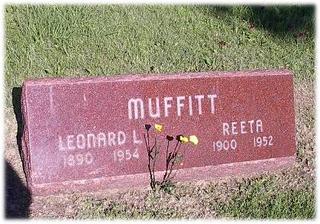
Leonard Muffitt

Leonard L. Muffitt
(from the Kinsley Mercury Newspaper July 20, 1954)

Leonard L. Muffitt, Old Timer Here, Dies Monday
Leonard L. Muffitt died Monday at the Edwards County Hospital after a short illness. Mr. Muffitt was forman of the local Kansas Power and Light plant and was serving his 31st year with the company.
Funeral services were held at McKillip's chapel at 2:30 Wednesday afternoon with Rev. Martin Pullman officiating. Interment and graveside services were at Wayne cemetery at Lewis, Kansas.

Mr. Muffitt is survived by four daughters, Mrs. Bill Scheuman, Murdock; Mrs. Clyde Smith, Wichita; Mrs. Raymond Roeabaugh, Geonosa, Colo. and Mrs Henry Lewis, San Diego, Calif.
Two sisters, Mrs. Hazel Bushnell, Lansing, Mich.; and Mrs. Edna Altenburg, St. Petersburg, Fla; and one brother, Earl Muffitt, Kalvesta.


Kinsley Kansas Power and Light plant 1937


Leonard's mother was Mary Ann Johnson Darling (July 9, 1868 - July 31, 1953). Leonard was adopted by Alonzo Muffitt. Leonard's biological father was not known by the family.

note:
(DNA has indicated that Leonard's biological father was Calvin O Chase of 1890s Mackville, Kansas)

 
Mary Ann Johnson was the daughter of William H.H Johnson (01/15/1841 - 12/27/1910 Lewis KY) and Clara Thomas.

William H.H Johnson was the son of John Johnson (02/02/1800 - 01/28/1888 Mason, KY) and Harriett Wallingford (06/15/1807 - 09/17/1852)

This is the only Photograph that Dorothy (Muffitt - Preston) Smith had and "Dad" was written on the picture with the arrow.


(January 15, 2011)
Although not much of Leonard was previously known, thanks to recently found descendants of Leonard's mother (Mary Ann Johnson - Darling -Muffitt -Leary),  A little more is now known ! 

Leonard's mother Mary Ann Johnson (born in Indiana), was the daughter of  William Henry Harrison Johnson (Wm H. H. Johnson, of Kentucky) and Clara Thomas (of Kentucky). Wm H. H. Johnson and Clara had two children Harriet and Mary Ann.  Clara died in Hickory Co., Missouri (no death record has been found).   Wm H.H. Johnson took the two little girls (Harriet and Mary Ann) and went back to Kentucky.  He then married Mary Francis Holland and had 2 more children, John and Clarissa.  They moved to Kansas and then Mary Francis died.

Then, according to family stories, Wm H.H. Johnson met and married 'other' women. 3 more,  may be 4 more. One was a widow with a big farm and when she found out about all the other wives, she kicked him out.  These stories are from Wm H. H. Johnsons' daughter Clarrisa (from the Wm H.H Johnson's second marriage) and she said that  Wm H.H. lived with them in between all the different women and she remembered him. She said he had a deep speaking voice and dark auburn hair and wore all his medals (from the Civil War) when he went to the GAR meetings. He always said he was younger than the age on his marriage records. She said she thought that he looked young for his age, so he fooled some of the women!


According to some remembrances of relatives in Kansas, Mary Ann was married first to a "Mr. Darling".  But no marriage or divorce records have been found to date.   He was always referred to as "the handsome Mr. Darling" according to relatives stories.  It is said that Mr. Darling did not like kids and left Mary Ann when he found out she was pregnant (with Leonard).   No Birth record of Leonard has been found but census records indicate that he was born in Kansas..


Leonard was born before Mary Ann married Alonzo Muffitt in 1893.  Leonard always went by the name of "Muffitt", although no adoption records have been found.  In Alonzo's obituary it states that Leonard is a step son.  Alonzo was from Michigan, the son of John Muffitt and Julia Strong.  Alonzo was married first to Amelia French.  Alonzo and Amelia divorced and then Alonzo married Mary Ann Johnson-Darling. Alonzo and Mary Ann had  three children together ( Edna, Hazel, Clyde "Earl" ) + Leonard.  We do not know where Alonzo and Mary Ann met. A granddaughter of  Hazel  asked Hazel and the reply was that she did not know where they met. 


Mary Ann's sister, Harriet Johnson married Will Becker. Will and Harriet had a son Bill who married Anna. The Beckers lived in Kansas as well.  They owned a lot of land and oil wells in Kansas.. Leonard was very friendly with the Beckers.   Leonard and Bill Becker were 1st Cousins.  

Not much is known about how and when Leonard met Ruth Preston.  And not much is known about what happened when Ruth died giving birth to the twin girls (Dorothy & Louise).   For years, on the Preston side of the family, the story was that Leonard 'left' and Ruth's mother Daisey raised the girls.  Although we have family stories that Leonard did make an attempt to reconnect to the twins when they were adults....not much is known.  Leonard was not discussed much, if at all.

 A recent connection to descendants from Leonard's half siblings provides 'the other side' explanation of events.

"The story we were told was that when Ruth died, Leonard could not take care of 2 new born babies and Daisey took them and wouldn't give them back when he remarried.  Leonard 2nd wife was  jealous of the girls and couldn't have children, so she wanted to adopt 2, which they did."


When Leonard died (1954), several half sisters and cousins ( from Michigan) attended the funeral and it was thought that the girls (twins Dorothy and Louise) were there.   Later, a descendant from one of  Leonard's half siblings, found the twins names in Leonard's obituary and tried to contact them but the letters were never answered or returned.  The Muffitt 'side of the family' never knew what happen to the Twin's. as reported:

"I have been working on the Muffitt tree for many years and always wondered if the twins had children."


Leonard's nieces and nephew have fond memories of Leonard.  They they would often go to stay at his house during the summer.  He would always show them the sites.  A nephew recalls being driving around in Leonard's 'big ol Buick'   The 1930 Census show that Leonard's step father Alonzo (age 80), was living with Leonard in Kinsley, Kansas.


Mary Ann divorced Alonzo (date unknown) then married Walter Leary.  She ended up in Michigan and lived near her granddaughter (that she raised ).  Her daughters (Edna and Hazel ) also ended up in Michigan.  Mary Ann died July 31, 1953.

Photo of Leonard Muffitt acquired
rom a member of the Muffitt family